Estimated increase
—
at your next renewal
Ontario · Auto Insurance · Updated July 2026
Just had the accident? Start with the step-by-step guide — or answer three quick questions. We'll tell you who Ontario's official Fault Determination Rules likely blame, and roughly how much your premium could change at renewal — in plain English.
Step 1 — What happened?
Describe your accident in your own words, or tap the closest match below. Ontario assigns fault by matching your crash to a set list of scenarios in the law (Regulation 668) — not by weather, road conditions, or whether police laid a charge.
Matched scenario
—
—
—
or tap the closest match
Rear-end & chain reactions
Turns & intersections
Lane changes & merging
Parking, reversing & doors
Single vehicle & road hazards
Theft, weather & damage while parked
Other drivers & road users
Not a collision
Step 2 — A few details
A rough number is fine. If you pay monthly, multiply by 12. (Paying $200/month = 2400.)
It's an optional add-on (often called OPCF 39). Not sure? Pick "Not sure" — we'll show you both outcomes.
This matters: Ontario has a special rule for very small accidents (explained in your result).
Step 3 — Your driving history
Last two questions.
Only a conviction counts — meaning you paid the fine or were found guilty. A charge that gets withdrawn never touches your insurance.
Estimated renewal outcome
Estimated increase
—
at your next renewal
New yearly cost
—
—
On your record
—
—
Next step
Insurers weight accidents very differently — the spread between quotes after a claim is often bigger than the surcharge itself. A licensed Ontario broker can shop your file across multiple companies at once, free.
✓ Request received
A licensed broker will reach out within one business day. Have your current policy and renewal letter handy — it makes the comparison faster.
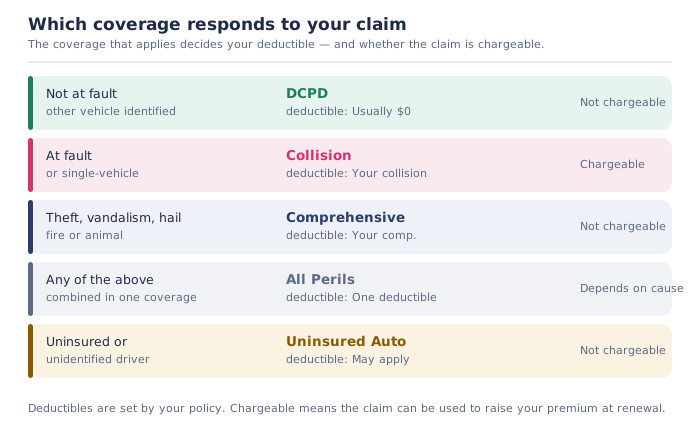
Ontario auto policies are built from separate coverages, and which one responds decides your deductible and whether it counts against you. The calculator tells you which applies to your situation — here's the whole map.
| Coverage | What it responds to |
|---|---|
| Direct Compensation – Property Damage (DCPD) | Your vehicle damage in a not-at-fault collision with an identified, Ontario-insured vehicle. Usually no deductible. Not chargeable. |
| Collision or Upset | At-fault collisions with another vehicle or an object, and single-vehicle accidents. Your collision deductible applies. |
| Comprehensive | Theft, vandalism, fire, hail, flood, falling objects, animal strikes and glass — the "other than collision" causes. Not an at-fault accident. |
| All Perils | Collision and comprehensive combined in a single coverage with one deductible — plus the one thing neither covers alone: theft by someone who lives in your household or works for you. |
| Specified Perils | A cheaper, narrower alternative to comprehensive: only the causes named in the policy (fire, theft, lightning, hail and similar). If your cause isn't on the list, it isn't covered. |
| Uninsured Automobile | Damage and injuries caused by an uninsured or unidentified driver. Included on every Ontario policy. |
| Accident Benefits | Injury benefits from your own insurer regardless of fault. Medical, rehab and attendant care are automatic; income replacement and others are optional since July 2026. |
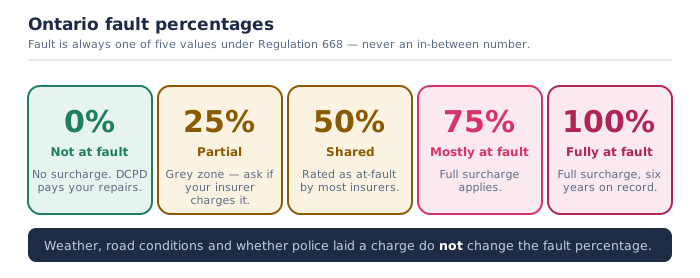
For insurance, fault is assigned by your claims adjuster using Ontario's Fault Determination Rules — Regulation 668 under the Insurance Act. It's a fixed list of more than 40 crash scenarios with a fault percentage attached to each one: 0%, 25%, 50%, 75%, or 100%. Your adjuster matches your accident to the closest scenario.
Three things about these rules surprise almost everyone:
| Scenario | Typical fault |
|---|---|
| Rear-ended a vehicle ahead in your lane | 100% you |
| Rear-ended while stopped or driving straight | 0% you |
| Left turn across oncoming traffic | Usually 100% turning driver |
| Both vehicles changing into the same lane | 50 / 50 |
| Hit while legally parked | 0% you |
| Single vehicle (pole, ditch, guardrail) | 100% you |
| Hit-and-run, reported to police | 0% you |
| Hit an animal directly | Comprehensive claim — no fault |
Disagree with the fault your adjuster assigned? There's a specific escalation path that works — see how to dispute a fault determination. And if your car was struck while parked, this covers exactly who pays.
Parking lots are not automatically 50/50. That's a myth — the regulation has its own parking lot scenarios (a car backing out of a spot is normally fully at fault against a car driving down the lane, for example).
FSRA's consumer guidance says a finding of 50% or more can raise your premium at renewal. In practice, many insurers treat any fault above 0% — including 25% — as a chargeable claim in their own filed rating rules. So: at 0% you're protected; at 50%+ expect an increase; at 25% it depends on your insurer, and it's worth asking directly.
Ask your adjuster which Fault Determination Rule number they applied — they have to tell you. If the scenario doesn't match what happened, send evidence: dashcam footage, photos, independent witnesses. If you're still stuck, escalate to the insurer's complaint officer, and after that to the General Insurance OmbudService (GIO), which is free.
Ontario insurers are not allowed to use a minor at-fault accident to increase your premium — but only if all of these are true. (The rule dates from 2016; the damage threshold was raised from $2,000 to $5,000 in 2025, so older articles still quoting $2,000 are out of date.)
This protection applies to one minor accident every three years. It's the reason paying out of pocket for a true fender-bender can be smart: the moment your insurer pays even a dollar — including to the other driver — the accident becomes a normal chargeable claim.
At-fault accidents: 6 years from the accident date — not from when the claim closed or paid. That's the standard rating window in Ontario, though a few insurers look back further for their best claims-free discounts. The financial sting is heaviest in the first 2–3 years and tapers if you stay clean.
Convictions: 3 years from the conviction date — the day you paid the fine or were found guilty, not the day you were charged. If you fight a ticket for a year, the clock starts later. Demerit points themselves don't set your premium; the conviction does.
Every insurer sees both. When you apply anywhere, they pull your Autoplus report (all claims, industry-wide) and your driver's abstract (convictions). There is no insurer that "won't find out."
Forgiveness (commonly the OPCF 39 endorsement, or an insurer's own version) waives the rate increase on your first at-fault accident. Three things people find out too late:
The claim still exists and still shows on your Autoplus report. Forgiveness just stops your current insurer from charging you for it.
Shop around after a forgiven accident and the new insurer sees an at-fault claim — your old company's forgiveness means nothing to them. After a forgiven accident, staying put is usually cheaper than switching for the next few years.
A second at-fault claim inside the 6-year window is rated in full — and at that point some standard insurers move you toward the high-risk market instead of renewing.
If you're 0% at fault, your insurer can't raise your premium because of the accident. Your vehicle repair is normally handled under Direct Compensation – Property Damage (DCPD): your own insurer pays for your repairs even though the other driver caused the crash, usually with no deductible.
As of July 1, 2026, Ontario made most accident benefits optional — the biggest change to the standard auto policy in decades, and it applies to everyone immediately, regardless of your renewal date.
Still automatic: medical, rehabilitation, and attendant care benefits.
Now optional (you must choose and pay to add them): income replacement if you can't work after a crash, non-earner benefits for students and the unemployed, caregiver benefits, and several others.
Two catches worth knowing: the optional benefits you buy generally only cover you, your spouse, your dependants, and listed drivers — not, say, a cyclist you injure, who may now have to sue instead. And if you do nothing, your policy renews with whatever selections carry over — so review it rather than assuming you're covered the way you used to be.
Quick answers below — or browse the full FAQ: 29 questions covering the scene, police, injuries, rentals, and more.
This tool matches what you describe to a scenario in O. Reg. 668, the regulation every Ontario insurer uses. You can read every rule yourself — each one is set out in plain English with the fault split, a diagram, and its own link so you can cite it when you speak to your adjuster.