How your total loss offer was actually calculated
Almost nobody explains this part, so here it is plainly. When your vehicle is written off, an adjuster orders a valuation report from a third-party system. That system searches recent listings for similar vehicles, applies some standard adjustments, and returns a number. The adjuster reviews it and makes you an offer.
It is a reasonable process. It is also a desktop process — built from limited information, at speed, by someone who has never seen your car. The report doesn't know about your winter tire package. It doesn't know you replaced the brakes in March. It may have matched your loaded trim against a base model three hundred kilometres away.
Which is also why insurers revise offers regularly — when someone supplies the missing information in a form they can act on.
The catch: the burden of supplying it sits with you. Nobody is going to phone and ask whether your car had a sunroof.
Where the money goes missing
Five things account for most of the gap between an initial offer and a fair one. Each is checkable in minutes.
| What gets missed | Why it happens | Typical impact |
|---|---|---|
| Trim level mismatch | A base-model comparable priced against your higher trim | $1,000–$3,000 |
| Options and packages | Sunroof, tow package, winter tires, driver-assist — not in the file, not in the number | $500–$2,500 |
| Mileage not adjusted | Comparables with far more kilometres averaged in without correction | $400–$2,000 |
| Recent replacements | New tires, brakes, or major service a listing-based valuation can't see | $500–$2,000 |
| Geography | Listings pulled from a cheaper market than your own | $300–$1,500 |
Illustrative ranges based on how vehicle valuations are constructed — your actual gap may be larger, smaller, or zero. The only way to know is to check.
Notice what these have in common: every one is a documentation problem, not a dispute. You're not arguing about opinion. You're supplying facts that weren't in the file.
What this looks like in real numbers
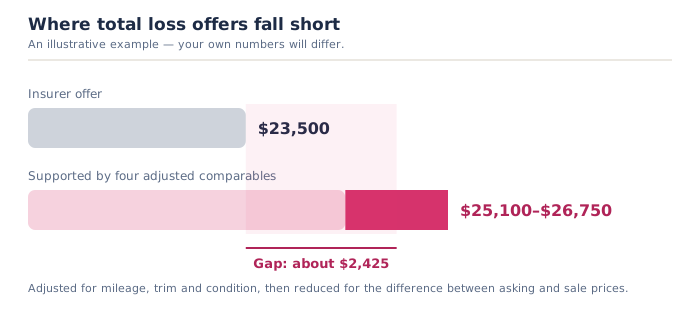
A 2019 sedan, 88,000 km, mid-level trim with a sunroof and winter tire package. New tires and brakes eight months ago. The offer arrives:
Nothing here is aggressive. No accusations, no lawyer, no complaint. Three listings, adjusted properly, presented clearly — and the conversation changes, because now there's something specific to respond to.
That's the actual trade you're deciding on right now.
Check my offer →Check this first: OPCF 43 waiver of depreciation
Before anything else — if you bought your vehicle new and it's still fairly recent, one endorsement can make the entire market-value question irrelevant.
What it does: the waiver of depreciation (OPCF 43) removes depreciation from a total loss settlement. Instead of paying actual cash value — what the car was worth the day before the crash — the insurer settles based on the original purchase price or MSRP. On a two-year-old vehicle that difference is often $5,000–$15,000.
Do you have it?
- Look at your policy declarations page for "OPCF 43", "43R", or "waiver of depreciation". If it's listed, it applies.
- It generally requires the vehicle was bought or leased new (some insurers include demonstrators). A used purchase normally can't carry it.
- It's time-limited — commonly the first 24 to 30 months from purchase, depending on the insurer and the version of the endorsement.
- It must have been added and paid for. It's optional coverage, not automatic.
How a total loss payout works — in 4 lines
- Your car is a write-off when repairs approach its value. You're owed its actual cash value — what it would have sold for the moment before the crash.
- Not what you paid. Not your loan balance. (Only OPCF 43 changes that.)
- The offer comes from a valuation report built on comparable listings — and you're entitled to see the whole report.
- Offers get revised when new evidence justifies it. Complaints without evidence don't move anything.
- The full valuation report, including every comparable vehicle used.
- The options list the value was based on — check it line by line against your car.
- Confirmation that HST is included in the settlement.
What moves the number up
- Better comparables — same trim, similar km, your region. A base-model comp against your loaded trim is the most common lowball.
- Maintenance records — new tires, brakes, a recent timing belt: documented recent spend is real value.
- Options the report missed — check the report's option list line by line.
- Mileage math — if their comps have 40,000 more km than yours, each should have been adjusted upward. Verify they were.
- HST — the settlement should account for the tax you'll pay replacing the vehicle.
Why most people accept the first offer anyway
Three reasons, and none of them are about the money.
- "They're the experts." The valuation looks official, so it feels final. It isn't — it's an opening position built from partial information, and revisions are a normal part of the process.
- "I wouldn't know what to say." This is the real blocker. Most people can sense the number is light but have no idea how to express that in terms an adjuster can act on. "It feels low" goes nowhere. An adjusted comparables table gets a response.
- "It's not worth the hassle." Understandable after a crash — except the hassle is roughly fifteen minutes, and the typical gap runs to four figures. There are few better returns on a quarter hour of your time.
They work from what's in the file. Put better information in the file, in a format that's easy to verify, and the number can change. That's the whole mechanism.
How to check your offer in about fifteen minutes
The Valuation Review tool walks you through the same steps a professional review would:
- Your vehicleVIN validated and decoded, trim, mileage, options, condition — the details a desktop valuation usually misses.
- Your offerThe settlement figure, deductible, and whatever the valuation summary told you.
- Real comparablesYou pull listings from AutoTrader, Kijiji or Marketplace. The tool adjusts each one for mileage, trim and condition against your vehicle — and validates the VIN of every comparable.
- Your reportMarket evidence, documented adjustments, a supported valuation range, and the gap to your offer — assembled as a professional document.
- Your negotiation packageWhere to open and when to stop. The seven things adjusters say when they push back, with the exact reply to each. A day-by-day follow-up sequence. And the escalation path most people never learn exists.
The full report
Freefor a limited time · $39 later
Free while we validate it. We're checking this tool against real Ontario claims before it becomes a paid product, so the full report — evidence, adjustments, negotiating position and the response playbook — is unlocked at no cost right now. All we ask is that you tell us whether the numbers looked right.
If your offer already sits inside the supported range, the report says so plainly. A tool that always finds a gap would be worth nothing.
Evidence gets you a response. Knowing what to say next gets you paid.
Here's where most people lose. They send a reasonable message, the adjuster replies with something like "our valuation comes from a licensed third-party system" or "asking prices aren't sale prices" — and that's the end of it. Not because the reply was unanswerable. Because they didn't know it had an answer.
Every one of those responses is standard, predictable, and has a specific reply that moves the conversation forward. Both of those examples, for instance, are things you should agree with before narrowing — conceding the fair point is what makes the rest of your position credible.
You get both: the seven responses adjusters actually give, what each one really means, and a written reply for each you can copy and send.
Plus the part almost nobody knows: your policy contains an appraisal provision under the Insurance Act. When both sides genuinely can't agree on value, either can invoke it — each appoints an appraiser, they select an umpire, and agreement between any two settles it. Simply knowing it exists changes how a stalled file gets handled.
What this is — and what it isn't
- A structured way to organize market evidence and documentation
- Adjustment math applied consistently and shown transparently
- A professional document you can send yourself, plus a playbook for the replies
- Built by people who understand how Ontario claims are handled
- Not a certified appraisal — for a formal appraisal, hire a licensed appraiser
- Not legal or insurance advice
- Not a guaranteed outcome — insurers weigh evidence on their own terms
- Not adversarial — the tone throughout is cooperative, because that's what works
Five mistakes that cost people money
- Accepting the first offer without seeing the report. You're entitled to the full valuation and the comparables behind it. Ask before you respond.
- Not checking for OPCF 43. If the waiver applies, everything else is beside the point — and people find out too late.
- Comparing against the wrong trim. The most common and most expensive gap.
- Forgetting recent spend. New tires, brakes, or a recent major service are real value. Receipts matter.
- Signing the release too early. Cashing the cheque usually ends the conversation. Don't, while a review is outstanding.